
End-to-end testing for complete user journeys
Validate workflows that cross pages, services, roles, and connected systems. The End-to-End Testing Agent coordinates state, executes each step, and makes failures easy to replay.
See how agent-driven E2E testing handles your critical journeys.
Trusted by QA teams at




Capabilities
End-to-end test automation across connected systems
Validate complete business outcomes instead of testing each page or service in isolation.
Cross-system journey coverage
Test complete business workflows across the user interface, APIs, services, roles, and supported external systems instead of validating each component in isolation.
State and test-data orchestration
Prepare accounts, sessions, permissions, and test data before execution. Preserve or clean up state according to the needs of each end-to-end test.
Step-by-step failure replay
Reconstruct failed journeys with actions, screenshots, video, logs, and request context so developers can find where expected behavior diverged.
Workflow
How the End-to-End Testing Agent works
Model a business journey once, then execute and review it as a connected sequence.
1. Model the user journey
Define the starting state, user roles, business steps, connected systems, and expected final outcome.
2. Orchestrate and execute
The agent prepares required data and sessions, then follows the workflow across every participating component.
3. Replay and resolve
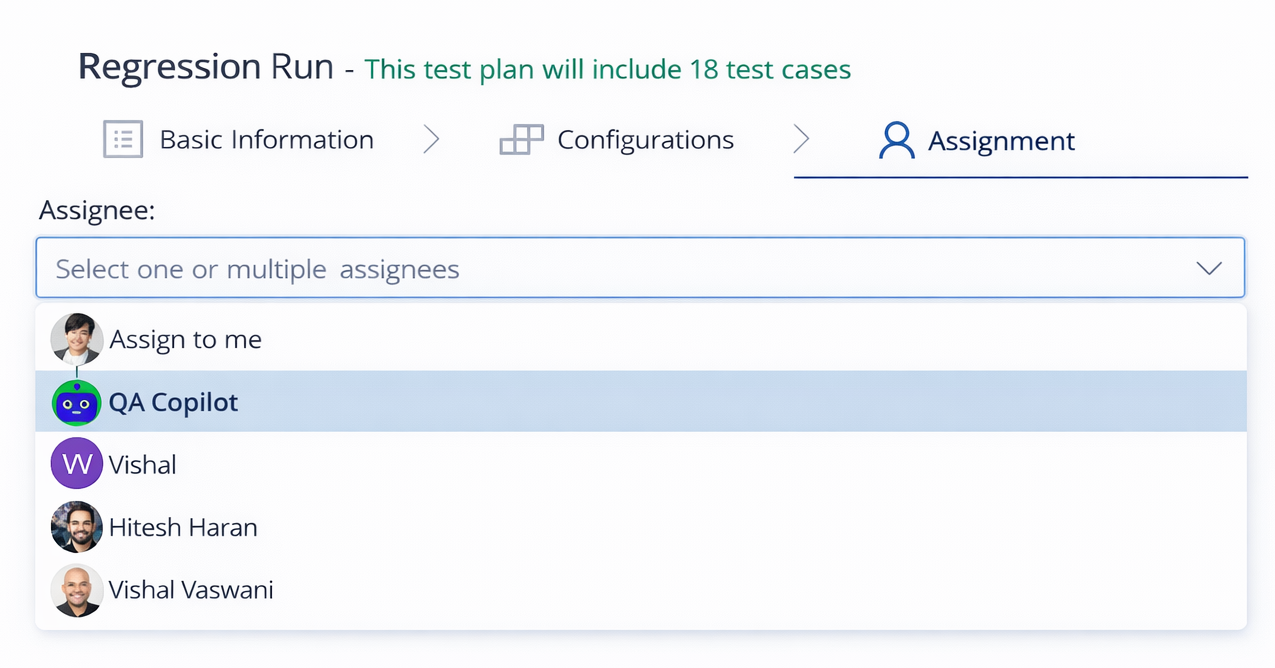
Review the exact failed step and supporting evidence, assign the issue, then automatically retest the corrected journey.
Evidence
E2E testing evidence across the whole journey
Follow the path from initial state to final business outcome without stitching together separate logs.
Journey execution timeline
See each completed action, checkpoint, system transition, wait condition, and result in the order it occurred.
Visual and session evidence
Inspect screenshots, video, browser logs, and sanitized session context for the exact point where a journey failed.
Cross-system trace
Connect interface steps with relevant requests, service responses, data state, timing, and the expected final outcome.
Platform
A controllable platform for end-to-end testing
Deploy, trigger, govern, and audit complete journey checks according to your engineering and security requirements.
Self-hosted with an open-source model
Use the managed service or deploy inside your VPC or on-premises with an approved open-source model. Keep code, credentials, test data, and results within your environment.
Webhook or scheduler triggers
Run after a deployment, pull request, release webhook, CI/CD event, API call, or recurring schedule. Manual runs remain available.
Safe access to private environments
Test staging sites, internal applications, and protected services with scoped credentials, allowlists, and read-only defaults.
Custom rules and thresholds
Set required journeys, expected outcomes, environment rules, timing limits, exclusions, and release thresholds.
Change-aware execution
Use code diffs, changed services, requirements, and risk labels to prioritize the journeys most relevant to a release.
Evidence with every finding
Capture pass, fail, and skip results with applicable screenshots, video, logs, traces, diffs, and source context.
Human-controlled release gates
Choose whether a failed journey informs the team, opens a defect, waits for approval, or blocks a release.
Connected delivery workflow
Route E2E results and evidence into TestCollab, issue trackers, source control, team channels, and CI/CD pipelines.
Audit-ready history and portable results
Retain configurations, model versions, runs, overrides, and approvals. Export portable results in formats such as JSON, JUnit, SARIF, and PDF where applicable.
FAQ
Answers teams look for
What is end-to-end testing?
End-to-end testing validates a complete user or business workflow from its starting action to its final outcome. It checks that the interfaces, services, data, and integrations involved work together.
How is end-to-end testing different from integration testing?
Integration testing usually verifies that selected components communicate correctly. End-to-end testing exercises a complete workflow from the user's perspective across all participating systems.
Can the agent handle login, roles, and test data?
Yes. Journeys can be configured with scoped credentials, user roles, session setup, test-data preparation, and cleanup rules. Sensitive access remains governed by your environment policies.
What evidence is captured when an E2E test fails?
Depending on the configured journey, evidence can include completed steps, screenshots, video, browser logs, request details, timing, and the expected versus observed outcome.
Test complete journeys before customers do
See how an end-to-end testing agent can coordinate state, execute workflows, and make failures replayable.